
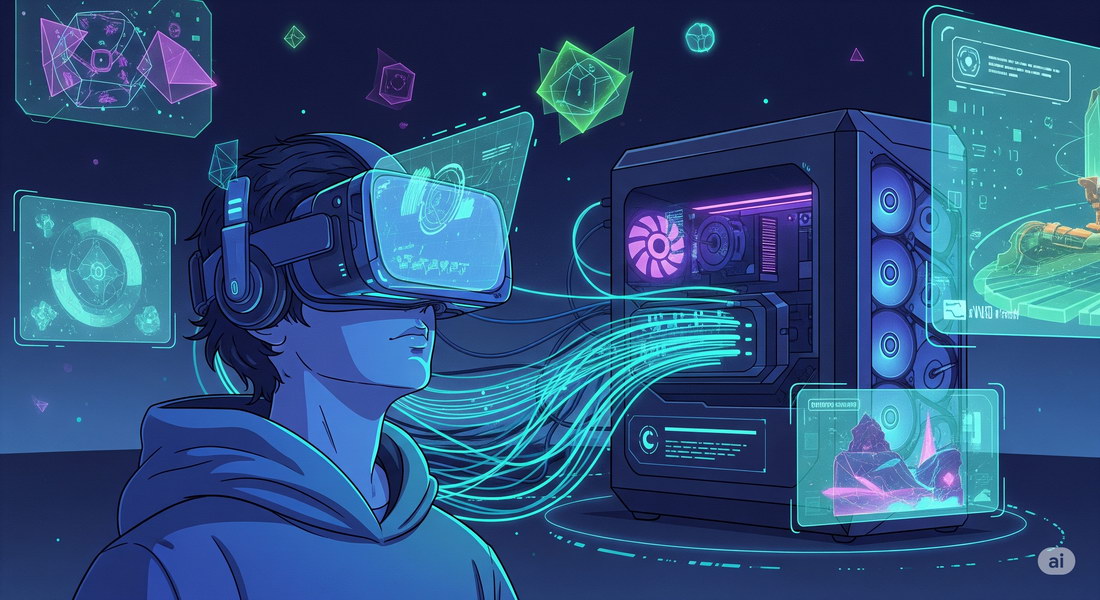
The Future of VR on PC: What’s Next After Half-Life: Alyx?
Half-Life: Alyx was a turning point for virtual reality on PC, proving that the medium could deliver a full-scale, AAA experience. Its success in 2020 raised expectations for what VR could become, inspiring developers and hardware makers alike. Since then, VR has evolved steadily, but the question remains: what comes after such a landmark release? In 2025, the PC VR landscape is at a crossroads, balancing breakthroughs in technology with the challenge of attracting wider audiences.
Half-Life: Alyx set the benchmark for immersive VR storytelling.
Before Alyx, many VR titles were tech demos or smaller-scale experiments rather than complete narrative-driven games. Valve’s release demonstrated that VR could carry deep storylines, complex mechanics, and cinematic presentation on par with traditional games. It showcased how environmental interaction and spatial design could enhance immersion in ways flat-screen games could not replicate. This gave players a glimpse of VR’s true potential when handled with care and ambition.
The impact of Alyx still resonates, as developers use it as a reference point for future projects. Players often measure new VR games against the standards it set, from hand-tracking fidelity to environmental storytelling. The game also proved that VR could be more than a niche, helping to legitimize the platform in mainstream conversations. Without Alyx, VR’s progress might have been slower and less assured.
Hardware advancements are pushing VR closer to the mainstream.
Since Alyx’s release, PC VR hardware has advanced rapidly, with headsets becoming lighter, sharper, and more affordable. Higher-resolution displays, wider fields of view, and improved refresh rates have made the experience far more comfortable. Inside-out tracking has eliminated the need for external sensors, simplifying setup for new users. These changes lower the barrier to entry and reduce the technical headaches that once discouraged adoption.
GPU improvements have also made a major difference, delivering higher fidelity at smoother frame rates. Technologies like foveated rendering and eye-tracking are helping optimize performance without sacrificing quality. As hardware matures, VR feels less like a novelty and more like a natural extension of PC gaming. The next step is to make these advances accessible at a price point that attracts larger audiences.
Game design for VR is evolving beyond simple interactions.
Early VR games often focused on novelty—waving hands, throwing objects, or standing in virtual environments. Today, developers are building deeper mechanics that integrate VR’s unique strengths into core gameplay loops. Genres like survival horror, simulation, and puzzle-solving have thrived, where immersion directly enhances tension and creativity. The best experiences now use VR not as a gimmick but as a meaningful tool for storytelling and gameplay.
Developers are also experimenting with longer, more complex games that rival traditional PC releases. Instead of short bursts, players can now enjoy full campaigns that feel complete and satisfying. Multiplayer experiences are expanding too, giving VR its own ecosystem of social and competitive play. This growth signals that VR design is maturing into something sustainable rather than experimental.
Social VR is shaping the future of online interaction.
While Alyx highlighted narrative potential, other VR applications are pushing the boundaries of social experiences. Platforms like VRChat and Horizon Worlds have shown how VR can create persistent digital communities. These spaces allow players to meet, collaborate, and create content together in real time. For many users, VR is as much about social connection as it is about traditional gaming.
As hardware becomes more common, social VR could evolve into the “next internet café,” where players gather virtually instead of physically. Tools for user-generated content are expanding, letting communities build their own worlds and games. This participatory culture mirrors the rise of modding in traditional PC gaming, but with added immersion. The potential for creativity and connection makes social VR a key driver of the medium’s future.
Challenges remain in accessibility and adoption.
Despite progress, VR still struggles with high costs, hardware requirements, and space limitations. Not every gamer has the budget or physical environment to accommodate a VR setup. Motion sickness remains an issue for some, though improvements in frame rates and design are helping mitigate it. These barriers limit the potential audience, keeping VR smaller compared to mainstream PC and console gaming.
Developers face challenges too, as creating VR games requires different skills and budgets than traditional projects. Many studios hesitate to invest heavily without guaranteed returns. This creates a chicken-and-egg problem: players want more games, but developers want more players. Overcoming these hurdles will be essential for VR to fulfill its promise as a mainstream platform.
The next big leap for VR may come from hybrid approaches.
Cloud gaming integration could help remove the barrier of expensive hardware by streaming high-quality VR experiences. Wireless solutions are also improving, reducing reliance on tethered setups and opening new opportunities for mobility. Hybrid designs that allow VR headsets to function both as standalone devices and as PC peripherals may broaden their appeal. These innovations could bring VR closer to the accessibility consoles once offered.
Cross-platform compatibility is another promising frontier, as players want flexibility to use VR across multiple ecosystems. Developers are beginning to design games that scale between VR and non-VR modes, expanding potential audiences. This hybrid approach ensures VR titles don’t remain locked to small communities. By blending convenience with depth, hybrid VR experiences may define the next stage of its evolution.
The future of VR on PC is full of potential, even five years after Half-Life: Alyx set the bar. Hardware has matured, game design has evolved, and social applications are creating new ways to connect. Challenges remain in cost, accessibility, and adoption, but innovation is steadily addressing them. If VR continues on this trajectory, the next landmark release could redefine gaming all over again, proving that Alyx was only the beginning of something much larger.


