
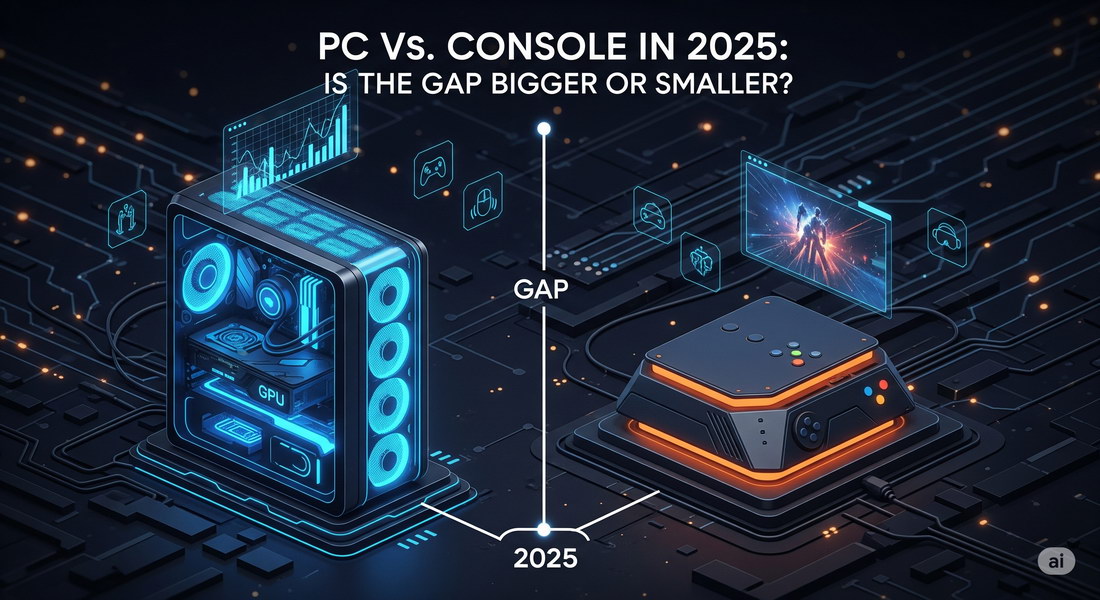
The debate between PC and console gaming has existed for decades, but in 2025 the conversation feels more relevant than ever. Both platforms have evolved rapidly, each offering unique strengths and experiences that appeal to different types of gamers. While PCs continue to dominate in flexibility and performance, consoles have narrowed the gap with affordability and convenience. The real question is whether the gap has grown wider or smaller as technology marches forward.
Performance differences remain but are less dramatic than before.
High-end gaming PCs still offer unmatched graphical power, capable of running the latest titles at 4K resolution and high frame rates with ray tracing enabled. Consoles, on the other hand, deliver impressive performance considering their cost, with the latest models offering 120Hz support and adaptive sync technologies. For many players, the visual difference between a powerful console and a mid-range PC is no longer as noticeable as it once was. This has made consoles an attractive option for gamers who prioritize simplicity and cost-efficiency.
However, PC hardware evolves at a faster pace, giving enthusiasts access to cutting-edge GPUs, CPUs, and storage solutions. The ability to overclock, customize cooling, and upgrade parts ensures PCs stay ahead of the curve. For those chasing maximum fidelity and performance benchmarks, a gaming PC still sets the standard. But the diminishing gap in graphical quality means fewer players feel pressured to invest heavily in PC hardware.
Consoles dominate accessibility while PCs master flexibility.
Consoles are designed for plug-and-play convenience, with little to no setup required beyond connecting to a TV or monitor. Game installations are streamlined, controller pairing is simple, and online ecosystems are integrated with subscriptions offering large libraries of titles. For casual or family-oriented gamers, this ease of use creates an accessible entry point that PCs often can’t match without technical know-how. This has kept consoles firmly rooted in living rooms worldwide.
In contrast, PCs offer unrivaled customization, letting players choose between keyboard and mouse, controllers, VR headsets, and specialized peripherals. Modding communities thrive on PC, allowing gamers to tweak visuals, mechanics, and even entire games to their liking. Streaming, content creation, and multitasking also favor the PC platform, making it more versatile. While consoles offer consistency, PCs remain the choice for gamers who want complete control over their experience.
Exclusive content is less of a divide than it used to be.
Historically, console exclusives were a major selling point, with franchises like Halo, God of War, and The Legend of Zelda defining their platforms. In 2025, however, more studios are embracing cross-platform releases to maximize their reach. Many former exclusives eventually launch on PC, either simultaneously or within a year, blurring the line between platforms. Subscription services like Xbox Game Pass also push games across both ecosystems, reducing the barrier between PC and console libraries.
That said, Nintendo continues to guard its exclusives carefully, maintaining a unique position in the market. Sony and Microsoft still offer early access advantages or console-first releases, but these windows are shrinking. PC gamers benefit from wider modding and indie game availability, while consoles enjoy curated libraries with optimized performance. The exclusivity battle still exists, but it is no longer as defining as it once was.
Price and value remain key factors for most players.
Building a capable gaming PC in 2025 is easier and cheaper than it was during the peak of hardware shortages, but it still costs more than a console. Consoles provide a strong price-to-performance ratio, with hardware subsidies and bundled subscription services adding value. For families or budget-conscious players, this makes consoles the safer investment. A single purchase ensures years of stable performance without worrying about upgrades or compatibility.
PCs, however, deliver value in other ways—such as cheaper digital game prices, massive libraries of free-to-play titles, and long-term flexibility. The ability to upgrade individual components means a PC can evolve gradually rather than requiring a full replacement. For those who also use their machines for work or creative projects, the investment makes sense beyond gaming. Ultimately, the value equation depends on whether players prioritize upfront affordability or long-term versatility.
Future trends may blur the line even further.
Cloud gaming and subscription services are changing the definition of platform exclusivity. With services like GeForce Now, Xbox Cloud Gaming, and PlayStation’s streaming offerings, gamers can play across devices with fewer restrictions. This trend reduces the importance of owning powerful hardware, since performance can be streamed from remote servers. If cloud gaming continues to grow, the distinction between PC and console ecosystems could become far less significant.
Meanwhile, hardware manufacturers continue to experiment with hybrid devices, handheld PCs, and console-like prebuilt rigs that combine aspects of both worlds. The convergence of technology points toward a future where platform choice matters less than the services and experiences offered. By 2030, the lines may be blurred to the point where debates about “PC vs. console” sound outdated. For now, though, players still weigh clear trade-offs between power, price, and convenience.
In 2025, the gap between PC and console gaming is both bigger and smaller, depending on how you measure it. PCs continue to lead in raw performance, customization, and versatility, while consoles dominate affordability, simplicity, and accessibility. Exclusive games and services are less of a dividing line than before, as cross-platform play and subscriptions bridge communities. Ultimately, the decision comes down to lifestyle and priorities, with both platforms stronger than ever—and the rivalry likely to continue for years to come.


